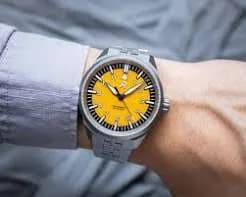
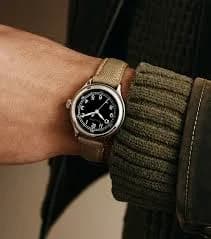
There's a persistent assumption in watch shopping: big wrist, big watch. But a growing number of large-wristed owners are deliberately choosing 32-36mm vintage-style pieces — and the results, and opinions, are genuinely mixed in an instructive way.
It Can Absolutely Work — With the Right Watch
Several owners with wrists in the 6.75-7.5 inch range reported that smaller vintage pieces (a 1970 Caravelle at 34mm, a 1942 Hamilton military watch at 32mm, a Waltham A-11 at roughly 32mm) looked genuinely classy rather than undersized. One specific piece of feedback captured the key insight well: a small watch on a big wrist can read as understated and confident rather than flashy — the opposite of what people assume happens when case size shrinks relative to wrist size.
But Wrist Width, Not Just Circumference, Matters More Than People Realize
This is the most useful technical insight from the discussion: two people can have similar wrist circumference measurements but very different experiences with the same watch, because what matters most is how wide (flat-to-flat) the wrist is where the case actually sits. One owner with a 7.25-inch wrist described it as unusually wide at the case-contact point, which made even a 42mm watch look smaller than its actual size — meaning the same person could likely wear genuinely small watches successfully too, since visual proportion depends on local wrist width, not just tape-measure circumference.
Where It Stops Working: The "Comically Small" Threshold
Not every account was positive. Owners with wrists at 8-8.5 inches specifically reported that anything under 38mm started to look disproportionate — one described a sub-38mm watch as looking like "a quarter on a strap" on an 8.25-inch wrist, and another flatly stated small watches "are for someone else" at 8.5 inches. This suggests there's a real threshold, not a purely subjective "wear what you like" answer — past a certain wrist size, case-to-wrist proportion becomes visually obvious even to casual observers.
The Bracelet/Strap Can Rebalance the Look
One nuanced point worth remembering: when a smaller watch sits on a larger wrist, the strap or bracelet itself starts doing more visual work — a wider, more textured, or higher-contrast band can help balance the proportion in a way a thin, understated strap won't. If you're testing whether a small watch works for you on a larger wrist, don't judge it on the stock strap alone.
"Quick Take": If your wrist is 6.5-7.5 inches, a 34-36mm vintage-style watch can genuinely look classy, not undersized — try it before assuming you need something bigger. Above roughly 8 inches, most people find anything under 38mm starts looking disproportionate.